The hardest part of communication is not simplifying the words. It is changing the way we think long enough to meet someone where they are.
It still happens to me mid-conversation. I am talking with someone I have grown close to, and without noticing, I switch into Russian. The other person does not speak a word of it. Somewhere along the way, my brain decided, “This is one of my people. We can use the native language now.”
I was born in Ukraine and grew up bilingual, with Russian and Ukrainian woven into everyday life. English came third. So I have spent most of my life translating, and I always assumed that made me good at it.
It took me years to realize I had been doing something very similar professionally.
The translator who wasn’t
For 23 years, I worked in technology at Merck. Somewhere along the way, technology became my professional native language.
The funny thing is, I thought I was already a good translator. One of my strengths was taking highly technical discussions and explaining them to business teams. I could bridge the gap between engineers and business leaders, and I genuinely believed that meant I knew how to communicate with nontechnical people.
Looking back, I realize we were often still speaking different versions of the same language. Engineers and business leaders may use different terminology, but they share a great deal of context. They understand projects, budgets, deadlines, stakeholders, compliance, and organizational complexity. Their worlds overlap much more than I appreciated.
Then I left corporate life and started my own business.
From the beginning, I knew one of my biggest challenges would be making technology and automation relatable to small business owners. So I experimented, constantly. I tried different words, different analogies, different stories, different examples. Some explanations immediately resonated. Others produced polite smiles and blank stares.
I still experiment today. I have not mastered this, but I have become much better. Not because I found a perfect set of simpler words, but because I began to realize that the challenge was deeper than vocabulary.
The nursing students
Another dot appeared through my part-time work helping nursing students run simulation exercises.
First-year nursing students have recently learned medical terminology. They are excited to use the professional language they have worked hard to understand. A student might ask a patient, “Have you been experiencing dyspnea?”
Technically, the question is correct. An experienced nurse is more likely to ask, “Have you been short of breath lately?”
Same question. Same information. A completely different experience for the patient.
The experienced nurse has not forgotten the medical terminology. She simply knows which language belongs in which conversation.
My mom and the gadget
Then there was my mom.
For more than a year, I tried to explain ChatGPT to her. I told her what artificial intelligence was. I described what it could do. I explained why I believed it would change how people work and live. None of it really clicked.
Then she had eye surgery and stayed at my house while I looked after her recovery. One day, she noticed a small Sony device sitting on my kitchen table.
“What is that?” she asked.
Instead of answering the question myself, I opened ChatGPT, took a picture of the device, and asked what it was. Within seconds, ChatGPT identified the gadget and explained what it did.
That brief demonstration accomplished what more than a year of explanations had not. My mom suddenly understood why this technology might be useful to her. She became interested in trying it herself.
It was not because I had finally found the perfect explanation. It was because, for the first time, AI answered her question instead of mine.
The advertisement that reads both ways
Another dot came from a story I heard during the Leadership and Innovation course in my MIT program.
The story described a three-panel Coca-Cola advertisement. In the first image, an exhausted man is crawling through the desert. In the second, he drinks a Coca-Cola. In the third, he walks away refreshed.
Read from left to right, the message is obvious: a struggling man drinks a Coke and feels better. But someone accustomed to reading from right to left could interpret the exact same images in reverse. A healthy man drinks a Coke and collapses in the desert.
Whether the story was a real campaign mistake or became a marketing parable over time is almost beside the point. The image stayed with me.
Same pictures. Completely different meaning. Not because one person was intelligent and the other was not, and not because the message was too complicated, but because people interpreted it through different frames of reference.
What the dots formed
For a long time, I thought good communication meant explaining something clearly. Then I thought it meant simplifying the language. Now I think both ideas are incomplete.
The hardest part is not changing the words. It is changing the way we think long enough to meet someone where they are.
Every expert develops a native language. Engineers have one. Doctors have one. Lawyers, accountants, marketers, and technology professionals all have one. Professional language is useful; it allows experts to communicate precisely and efficiently with one another. The challenge begins when we forget we have left the room. We assume the other person sees what we see, understands what we understand, starts from the same place we do.
Usually, they do not.
When I lay these moments side by side, I notice they are all the same lesson wearing different clothes. My brain switching to Russian with people I trust. The nursing student reaching for “dyspnea.” Me explaining AI to my mom in my language instead of hers. A desert advertisement that tells two opposite stories depending on which direction your eyes travel. In every case, the message was fine. The frame was the problem.
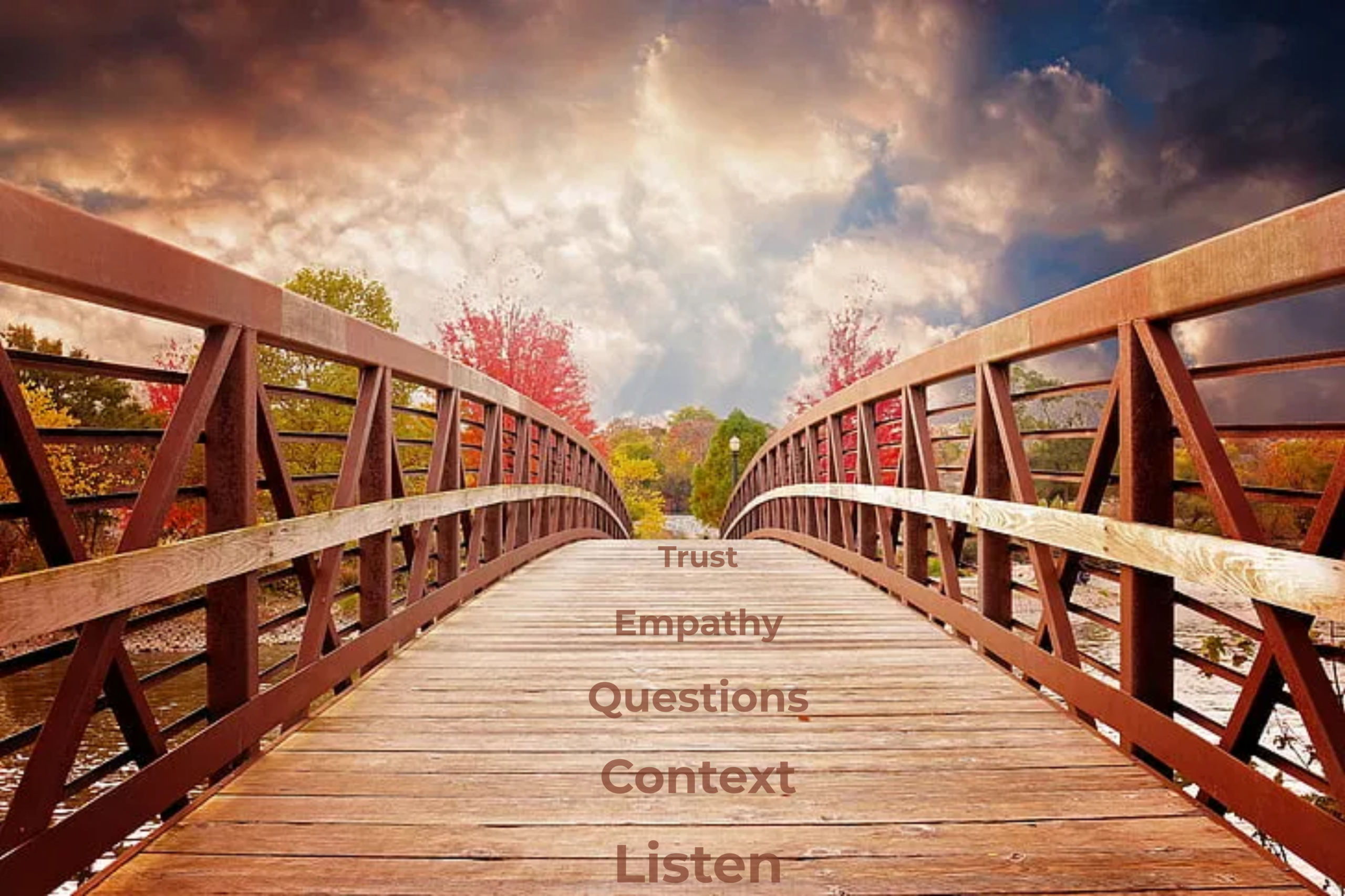
Artificial intelligence makes this lesson even more important, because AI can generate extraordinary answers but still depends on us to define the right problem. And defining the right problem begins with understanding another human being. It begins with listening, asking better questions, and noticing what matters to the person standing in front of us.
Looking back, I think the biggest lesson I have learned over the past three years is not about AI, or automation, or communication. It is about people.
People understand the unfamiliar through the familiar. That is why the best communicators do not simply explain better. They find a bridge between what they know and what the other person already knows. They help others feel heard and understood.
And perhaps that is the language we are all trying to learn.
This is part of Connecting the Dots, a series where I connect lessons from 20+ years in technology, running an automation business, and everyday life. The first article, on emergence and why working parts can still make a failing system, is here: What Emergence Taught Me About AI, Automation, and Systems
If you would like the next Connecting the Dots post delivered to your inbox, subscribe to TechyInHeels. I write about AI, automation, software, and systems thinking, especially how we can use technology to create more clarity and less stress for small business owners.